The case for integrated infrastructure: Moving beyond silos
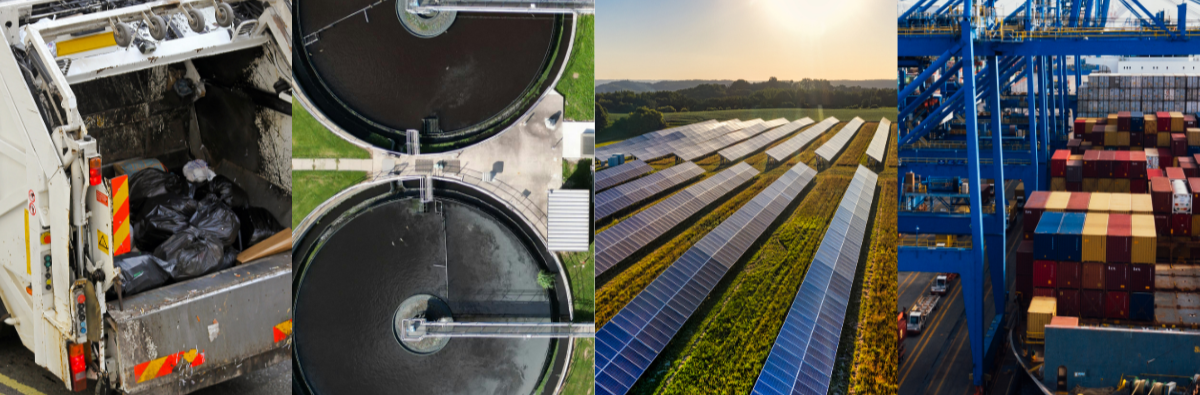
Australia plans and delivers its waste, water, and energy infrastructure in separate columns. Separate agencies, separate budgets, separate targets, and separate procurement processes. Yet the pressures these sectors face, and many of the answers to them, cut straight across all three.
At the recent roundtable Sphere co-hosted with Frontier Economics, Beyond Silos: Unlocking integrated outcomes across waste, water, energy and transport, brought together service providers, government representatives, councils, investors and regulators to test that premise. The conversation confirmed what many in the room already suspected: the silos are not accidental, but the cost of maintaining them is rising.
The opportunity hiding in the gaps
Each sector carries potential it cannot unlock on its own.
Wastewater plants generate organic material that can become biomethane for energy recovery and biosolids for land application. Recent Australian research on wastewater nutrient recovery makes the point that this resource is largely absent from both water policy and circular economy conversations, despite being viable at scale. FOGO organics collected by councils tell a similar story: run through anaerobic digestion they yield renewable gas and a compost product, but only where the offtake exists. Energy from waste can close the loop on residual material that cannot be recovered any other way, while producing baseload power that renewables alone cannot.
None of this is a pilot ambition. There are proven technologies available which are becoming more economically viable. The constraint is not capability. It is the fragmentation that stops the sectors planning and investing as one system.

What fragmentation costs
Each sector keeps a different scorecard. Waste counts landfill diversion. Water weighs public health and supply security. Energy concentrates on reliability and cost. Those metrics pull in different directions the moment infrastructure, a catchment or an investment case is shared.
Governance makes it harder. Analysis of local government waste delivery has shown how funding gaps and infrastructure inequities already block circular outcomes within a single sector. Add water and energy dependencies and the coordination problem multiplies. Australia has no mechanism to assess proposals that span all three sectors, no shared data, and no procurement designed to reward integration. So the projects most likely to deliver durable, co-funded outcomes are also the hardest to get across the line. Their proponents meet approval processes built for single-sector assets, revenue stacks that assume clean boundaries between gate fees, tariffs and energy offtake, and government counterparts who cannot commit across agency lines.
Where integration is already working
The picture is not uniformly stuck. Many water utilities are well advanced on energy self-sufficiency, pushed by state targets to cut consumption and shift to renewables. Some have committed to recovering their entire biosolids stream, treating the output as a resource rather than a disposal cost. Recent federal moves to extend carbon credit incentives toward biomethane and advanced waste treatment continue a financial signal to keep going with these ambitions.
Sphere's own work on long-term water procurement and energy-from-waste contracting shows that the commercial and risk structure integration needs already exist. The open question is whether they get used as a matter of course, or only where someone has already done the hard work of bridging the silos.
What the conversation needs next
Government needs to treat waste as significant infrastructure, with the planning, land and procurement support that designation carries, rather than leaving it to councils as a residual problem. The pipeline for integrated projects needs stable offtake and consistent policy, not another round of target announcements. And the players across these sectors need a reliable way to find each other, because most integrated solutions start with a relationship that crosses a boundary one side did not know was there.
That last shift is the work Sphere does. We bring delivery partners, operators, funders, councils and regulators into the same room, and we structure the commercial and risk arrangements that support the development of cross-sector projects.. Convening the conversation is the first step; turning it into bankable, deliverable infrastructure is the harder one, and the one that matters.
A white paper, and an invitation
Sphere Infrastructure, in collaboration with Frontier Economics, is developing a white paper on cross-sector integration in environmental infrastructure. It will examine where the structural barriers sit, what governance and commercial models are proving effective, and what a more coordinated approach to planning and investment could look like in an Australian context.
We want it to reflect the perspectives of people working across all parts of the system. If you work in water, waste or energy infrastructure, as a developer, an operator, a funder, a regulator, or an adviser, we would like to hear from you.
To contribute your perspective or register interest in the white paper, get in touch with the Sphere team or sign up to our newsletter to hear when it is released.
Further reading:
The evolving role of waste-to-energy in Australia's circular economy — Sphere Infrastructure
AORA Conference 2026: Moving Beyond Conversation to Industry-Wide Delivery — Sphere Infrastructure
Partnering for Tomorrow: Lessons in Long-Term Water Procurement Success — Sphere Infrastructure
Sphere Insights: The Quiet Contradiction in the 2026 Federal Budget for Water and Circular Economy Infrastructure — Sphere Infrastructure
To contribute your perspective or register interest in the white paper, get in touch with the Sphere team orsign up to our newsletter to hear when it is released.