Water, data centres, and the agreements that decide what gets built
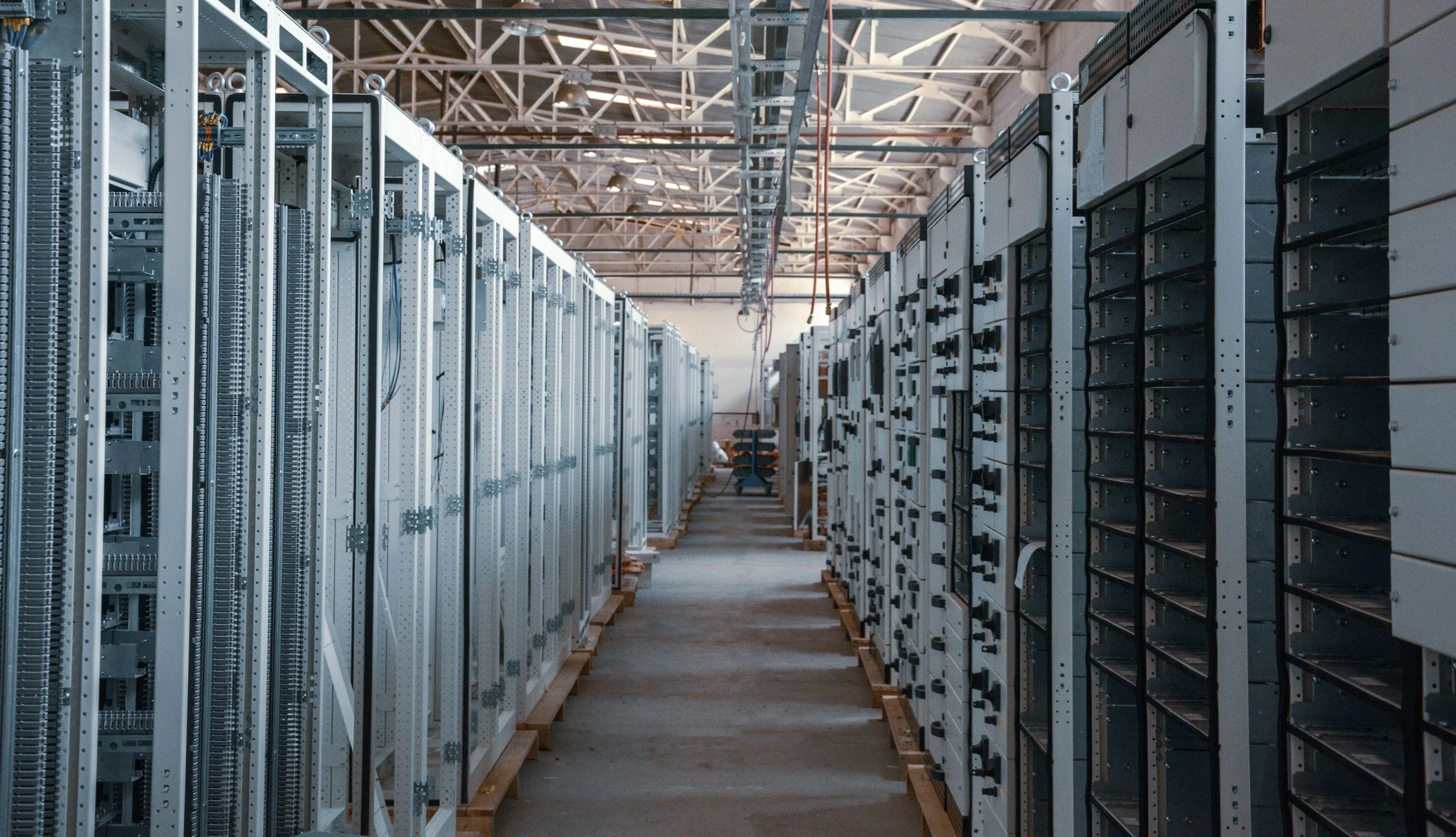
Australia already knows how to treat wastewater to the standard a data centre needs. What we have not worked out is how to arrive at a multi-party agreement that is fit for purpose over the lifecycle of a new type of water user, in a policy and regulatory landscape that is still moving. That, rather than the treatment train, is what decides whether circular water projects for data centres get built.
This article represents Sphere's reflections from Kate Dryden's keynote at CECE 2026, the International Conference on Circular Economy for Climate and Environment, held in Sydney on 25 September 2026.
The number that made us pay attention
Sydney Water puts data centres at under one per cent of Sydney's drinking water supply today, and estimates they could take up to twenty per cent by 2035. Under one per cent to a fifth, in under a decade, in one city.
The scale is easier to feel against something already built. In its submission to IPART, Sydney Water put the sector's likely demand at up to 250 megalitres a day by 2035. That is what the desalination plant at Kurnell produces, and Kurnell covers about fifteen per cent of Greater Sydney's supply. On the utility's own planning, one industry may need the equivalent of everything that plant can make.
The demand is also lumpy. Sydney Water has reportedly had enquiries from single facilities wanting up to 40 megalitres a day.
Nationally the picture looks very different. Australian data centres used around 5.5 gigalitres for cooling in 2025, roughly 0.04 per cent of the country's industrial water use. Both numbers are true. Water systems are catchments, networks and precincts rather than nations, and a figure that is trivial across a continent can be the whole servicing problem for one network in one part of one city.
Four governments, six months, What changed?
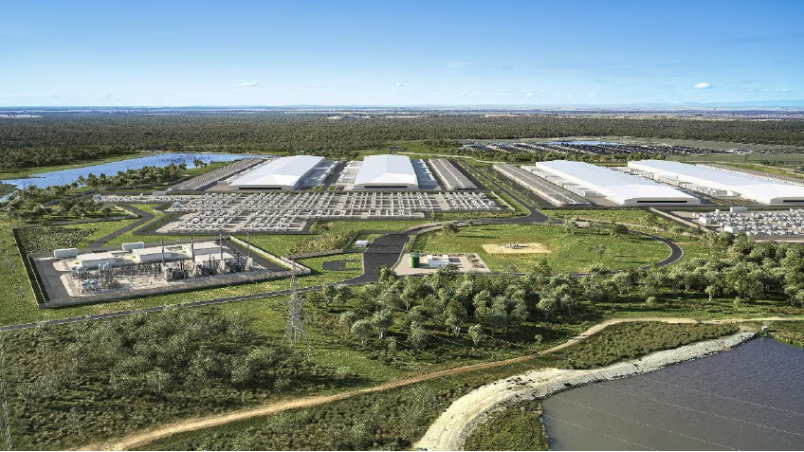
The concept model of a large-scale data centre project proposed for the Western Downs.
March 2026 - The Australian Government published its Expectations of Data Centres and AI Infrastructure Developers under the National AI Plan. One of five expectations focuses entirely on water: use non-potable sources where you can, pursue circular water opportunities, and cover your share of infrastructure costs.
August 2026 - NSW released its Data Centre Guidelines: six principles, seventeen performance measures. Water-intensive cooling must run on recycled water, or on an agreed transition to rainfall-independent supply. Interim potable use must be fully offset. The operator must secure an agreement with a water utility that protects everyone else from the cost of servicing it. In exchange, the operator must commit to assessing the development application within 75 days.
August 2026 - Queensland went the other way, excluding data centres from state strategic project declaration. A data centre is not a defined use in Queensland planning schemes, so the largest proposal in the country, the Western Downs Digital Park near Dalby, is assessed by a regional council against benchmarks written for other things.
September 2026 - Victoria announced that new data centres would be barred from using drinking water for cooling, required to match demand with new renewable generation and to fund their own connection costs. An election commitment rather than law.
September 2026 - The Commonwealth opened consultation on mandatory national minimum standards for any data centre above 30 megawatts, including four on water, such as paying a fair share of water infrastructure and servicing costs. Legislation is expected to follow.
Two things stand out.
First, the government has made the commercial water arrangement the price of speed. Seventy-five days, in exchange for a set of agreements that takes considerably longer than seventy-five days to negotiate. The NSW Guidelines are candid about it, saying they promote the use of commercial agreements for cost recovery while regulatory reform is pursued, and labelling the water agreement measure an interim step while IPART reviews how data centres should be charged. The state has said in writing that private contracting is holding the line until the framework catches up.
The second is that any snapshot of these settings dates quickly. All of the above happened in six months, and two consultations are still running.
Where the deal actually gets stuck
The straightforward arrangement is a water utility supplying a data centre directly, with drinking water or with recycled water. One alternative puts three parties in the chain. A municipal water authority holds the wastewater, with a planning horizon running to decades. A private recycled water utility sits in the middle, taking that wastewater under an access agreement, treating it to the standard the customer needs and delivering it under a separate commercial arrangement. A data centre operator is the customer, needing guaranteed volume, quality and continuity for an asset that might run fifteen or twenty years.
On paper, three sensible parties agreeing to something everyone wants. In practice, three risk appetites, three time horizons and three definitions of an acceptable worst case, all of which have to line up in one set of interlocking agreements.
Three questions have to be answered before anyone signs. What happens if the volume of available wastewater changes, through drought or a shift in the city's water strategy? Who wears it if a quality parameter drifts out of spec for the fortnight it takes to fix a treatment fault? And who is on the hook if the operator's own demand forecast turns out to be wrong in either direction?
That last one is not hypothetical. The NSW Guidelines cite work for AEMO estimating that six in every seven megawatts of data centre connection requests are phantom demand, with energy utilities putting the share of applications likely to proceed at about one in five. The same document notes that demand forecasts are commercially sensitive and should be provided in confidence. So the utility is asked to plan around numbers it cannot publish, for projects that four times in five may not happen.
Every one of those is an allocation question rather than a treatment question, and they take longer to resolve than the engineering does. Harder still, the three agreements have to close in an order, and each party needs something settled before it will sign.
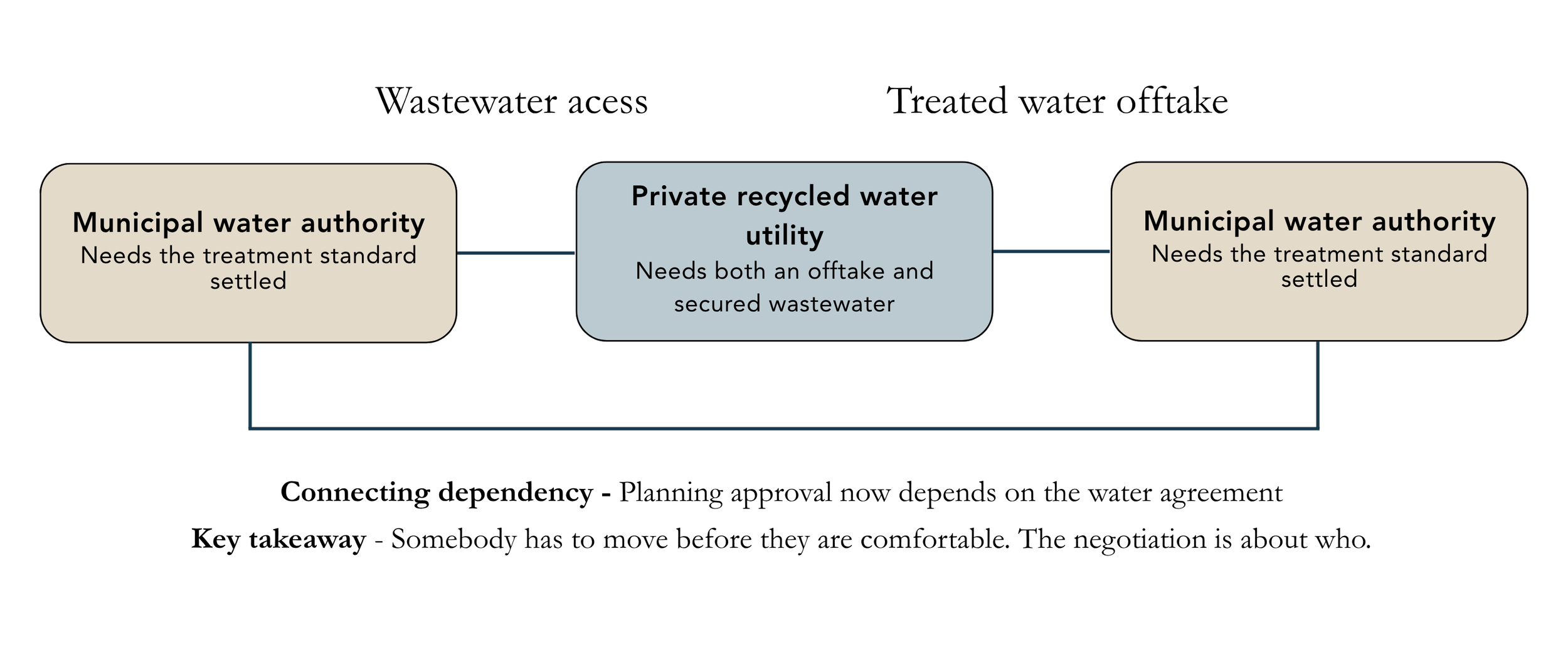
three parties, three agreements, one circular dependency
No committed input, no plant. No committed customer, no plant. Somebody has to break the circle by taking a position before they are comfortable, which usually means spending money at risk or accepting a contingent obligation. That takes time, and an expertise that is not water science.
The low-hanging fruit question, seen four ways
There is a serious objection to all of this, and Stuart Khan of the University of Sydney made it publicly again just last week. The NSW Guidelines say recycled water should be prioritised for cooling. The Greater Sydney Water Strategy dates from 2022 and did not account for data centre demand at all. Khan's point is that the recycled water schemes identified for the coming decades, up to 140 gigalitres a year, were identified for existing customers, and that handing that supply to a new industry raises the question of where the replacement comes from.
The question is no longer abstract. Sydney Water’s $1.2 billion Badu Yarragul facility at Kemps Creek opened last month, treating 35 million litres of wastewater a day with plans to double that, and recycled water from it is among the supply now being discussed for data centres. A second plant at Camellia-Rosehill is due in 2032.
So do data centres, arriving with deep pockets and long contracts, take the low-hanging fruit, the schemes already built and the sources close to where they are needed, and leave the expensive supply, desalination and the harder schemes, to be built and paid for by everybody else?
It is a real risk, and good intentions do not fix it. Contracts fix it, or they do not. It is also one lens on the problem, and there are three others worth holding at the same time.
Cost. The NSW Guidelines say a data centre's servicing costs should not land on other water users, and IPART is consulting on exactly that. It is asking who pays when new supply has to be built, and who wears the cost if that customer leaves or never arrives. It is also asking whether a privately licensed water provider is treated on the same terms as a public utility.
What the money buys. Leakage reduction has always been governed by an economic test. You fix leaks up to the point where the next repair costs more than the water is worth, and everything below that line stays in the ground. The same is true of a lot of asset renewal. A large customer funding an offset moves that line: water that was uneconomic to recover becomes economic to recover, because somebody else is paying and getting something they need in return. That only holds if the offset is real, verified, in the same system and locked into an agreement someone can enforce in ten years. Otherwise it is an accounting entry.
Which water. Purified recycled water is not one big pool. It is specific schemes at specific plants, chosen because the economics work there. A data centre scheme may not touch that water at all. A behind the meter sewer mining arrangement takes flow out of a sewer near the site, treats it there and uses it there. In a lot of configurations that wastewater was never headed for the plants the drinking water plans are built around. Often it would have gone out to sea. Sydney Water's own figure is that around 80 per cent of Greater Sydney's wastewater goes to sea after a single use, and the NSW Guidelines say recycled water helps defer the cost of upgrading coastal treatment plants and outfalls. So depending on where you draw the system boundary, the same project is either taking recycled water away from drinking supply, or taking load off an outfall and deferring capital the utility would otherwise have to spend. Like every circularity problem, the boundary you draw decides the answer you get.
Time. Everything above is a snapshot. The NSW Guidelines are reviewed annually. Queensland's position changed in August, Victoria's in September, and two consultations are open. Reading an allocation of recycled water off one guideline at one moment is likely to be wrong within a year.
There is a similar caution on the technology. Data centre water use gets discussed as though it were one number. The cooling choice moves it by an order of magnitude, and moves energy use in the opposite direction. The water-intensive facilities tend to be the ones without the land or the power to do it another way, which generally means metropolitan sites.
So this is not a question with one answer. It depends on the boundary, the timeframe and the contract. That is what makes it worth arguing about properly.
What would make these deals easier to strike
The treatment science matters. Better treatment trains, better monitoring and better ways to prove water quality in real time: all these technical solution make the commercial arrangements easier to reach, because each one removes a risk that somebody currently has to price. It is necessary without being sufficient. A process that works in a pilot plant still needs someone to structure the arrangement that lets it run at scale, for decades, across three parties who have not worked together before.
Bringing commercial advisers like Sphere Infrastructure in earlier helps, and we encourage players in the space to reach out. But the conversation only goes somewhere if there is something solid to price.
These deals are not hard because anyone doubts the technology works. They are hard because nobody can put a defensible number on the risk. If you are a utility, a developer, a technology provider or a government looking at a scheme of this kind, three things are worth settling long before anyone starts drafting.
Know which water you are actually using, and be able to show whose plans it does and does not sit inside. The system boundary is the argument you will be having with regulators, customers and the community.
Be able to evidence quality, volume and continuity in terms a counterparty can write a guarantee against, so performance gets measured rather than argued.
Work out early who has to move first, and what they get for carrying that risk. Sequencing is a commercial design question long before it is a drafting one.
Settle those three and the rest of the negotiation is ordinary commercial work. Leave them open and no amount of drafting will rescue the project. Sphere advises utilities, developers and governments on arrangements of exactly this kind, and we are glad to talk to anyone working on one.
The next generation of circular water projects in this country will not be won or lost in the treatment train. They will be won or lost in the term sheet. On Sydney Water's own numbers, there are about nine years to get good at it.
Sources
NSW Data Centre Guidelines, Infrastructure NSW, August 2026
Getting it right: Building AI infrastructure that works for Australia, Department of the Prime Minister and Cabinet, September 2026
Review of the water pricing framework for data centres, IPART, draft terms of reference, September 2026
Expectations of data centres and AI infrastructure developers, Department of Industry, Science and Resources, March 2026
Greater Sydney Water Strategy and the purified recycled water programme, Sydney Water
Sydney Water confirms new $1.2 billion recycling plant will supply data centres, ABC News, 6 October 2026